
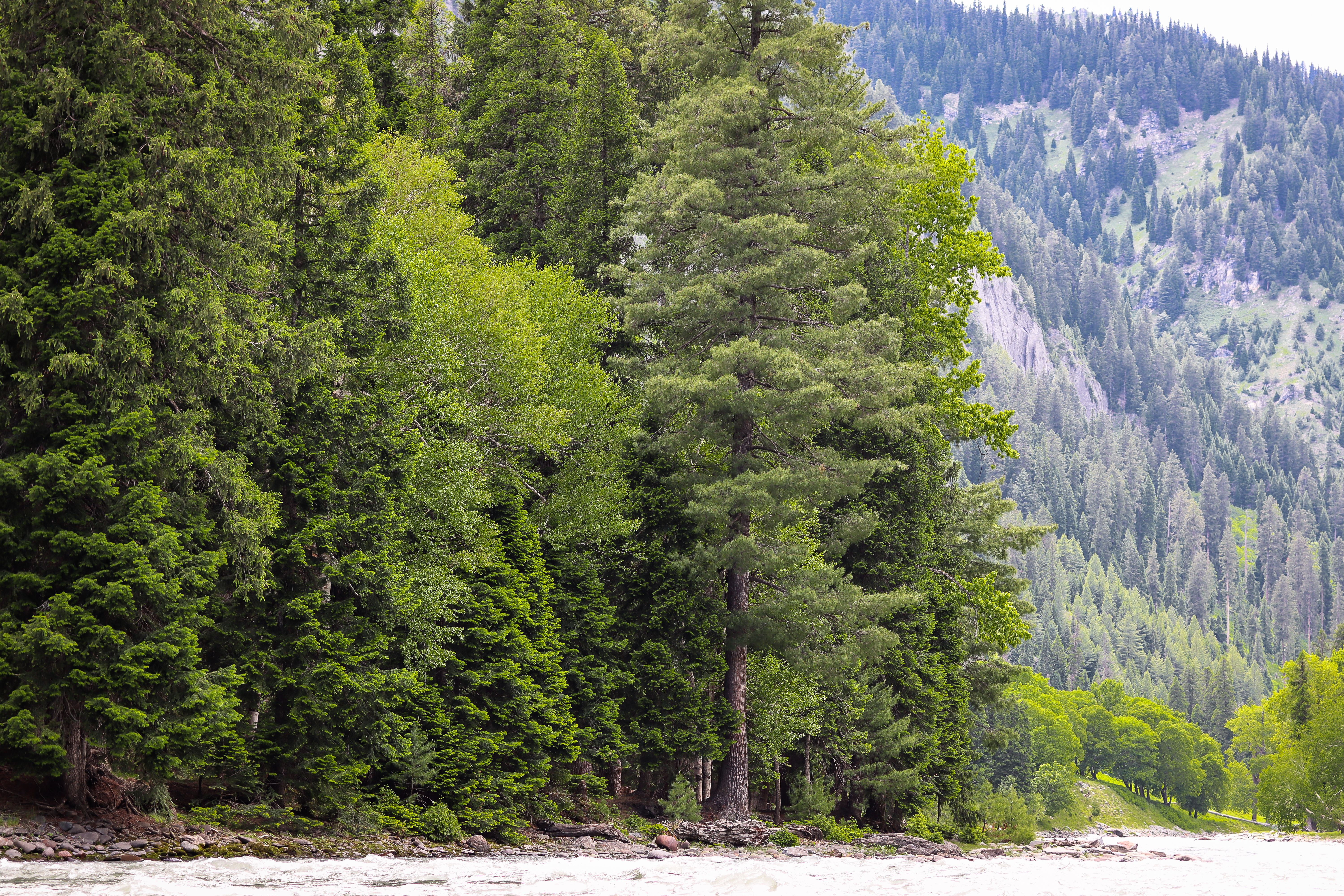
Cutting a forest in half creates two smaller forests and something else: a boundary strip with its own conditions. In fragmented country that strip can account for most of the remaining forest.
What changes at a boundary
An edge receives direct sunlight and wind that the interior does not, so it is warmer during the day, cooler at night, drier and more variable overall.
Humidity falls sharply, which matters most to amphibians, mosses, lichens and invertebrates that depend on stable moisture.
Light penetration also increases, encouraging dense growth of shrubs and climbers along the boundary, which further alters conditions a short distance inward.
How far the effect reaches
Microclimate effects typically extend tens of metres into a forest, while wind damage and changes in species composition can reach considerably further.
Different effects have different depths, so there is no single edge width. A forest may be interior for humidity while remaining edge-affected for predation.
The consequence for fragments is arithmetic. Below a certain size a patch has no interior at all, and everything within it experiences edge conditions.
Why trees fall more often near edges
Trees grown inside a closed canopy develop slender trunks supported by their neighbours, having never been exposed to strong wind.
When the neighbours are removed, those trees are exposed directly, and windthrow along a new edge is common in the first years after cutting.
Each fall opens the canopy further and moves the effective edge inward, so a fragment can continue shrinking biologically after the cutting has stopped.
Predators and parasites concentrate here
Nest predation is consistently higher near edges, because generalist predators from open country hunt along boundaries rather than deep in forest.
Brood parasites that lay in other birds' nests show the same pattern, using edges as access routes into forest they would not otherwise penetrate.
Forest-interior birds nesting in narrow fragments can therefore experience losses high enough that the patch consumes more individuals than it produces.
What softens an edge
Edges facing dense vegetation behave differently from those facing bare ground, since a structured boundary of shrubs and small trees blocks wind and light penetration.
Managers therefore plant buffer strips rather than leaving a hard boundary, which reduces the depth of the affected zone considerably.
Shape matters as much as area. A compact patch has far less edge than a long narrow one of identical size, which is why fragment geometry features in reserve design.