
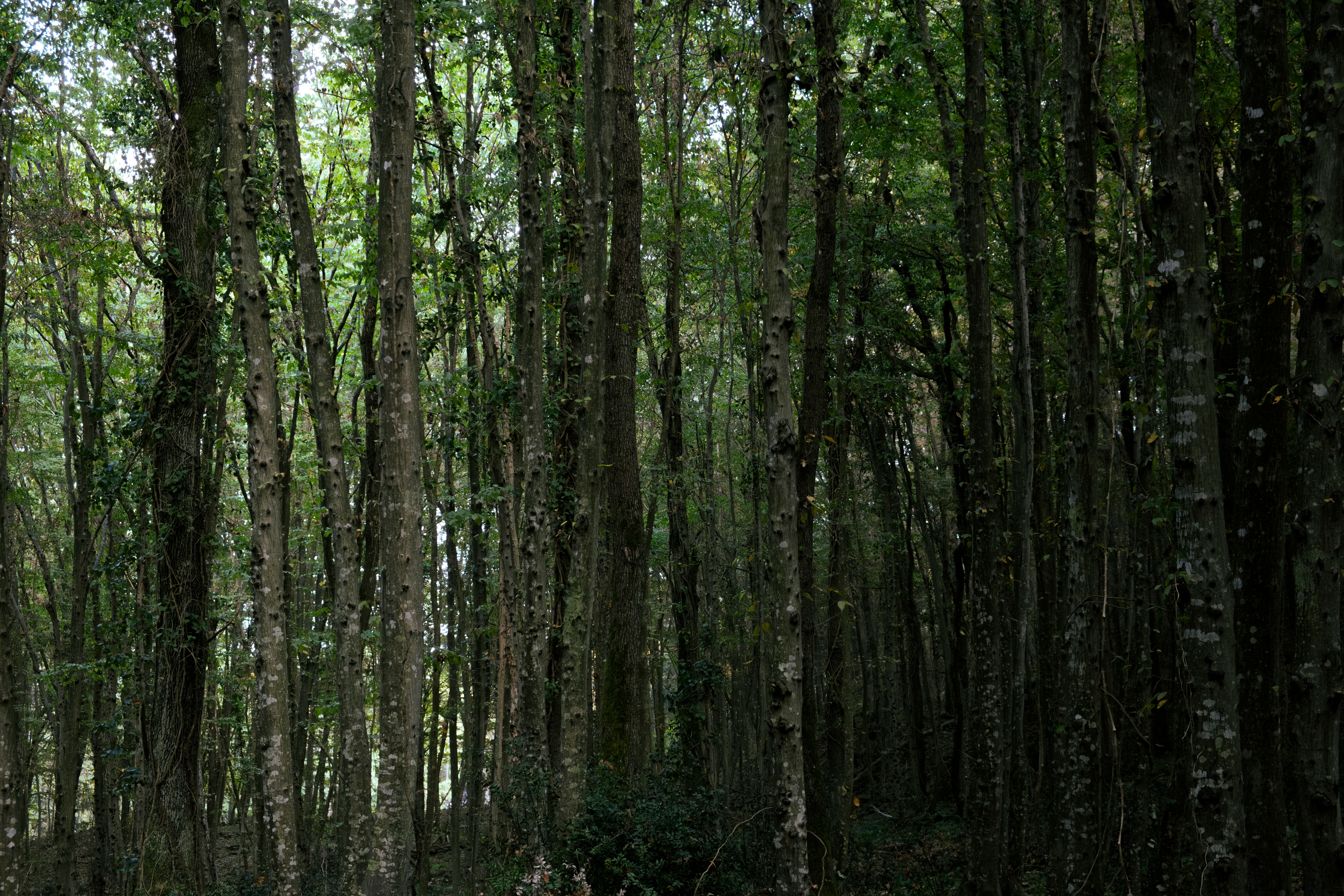
A dead tree remains part of a forest for decades, and a substantial share of forest species depend on it during that time. The dependency is specific enough that deadwood volume predicts species richness in many woodlands.
Decay proceeds in stages
A freshly dead trunk retains bark, firm wood and much of its structure, and the first colonists are bark beetles and the fungi they carry.
As decay advances the wood softens, bark loosens and falls, and moisture content rises. Different fungi dominate at each stage, followed by different invertebrates.
Late-stage material breaks down into soft, crumbling wood that holds water and merges into soil, supporting species found nowhere else in the forest.
Why fungi do the work
Wood is largely cellulose and lignin, and lignin resists decomposition strongly. Relatively few organisms can break it down.
White rot fungi degrade lignin and leave pale fibrous wood; brown rot fungi take the cellulose and leave a dark, cubically cracked residue. The two produce structurally different habitat.
Invertebrates that appear to eat wood are usually consuming fungal tissue within it, or relying on gut microorganisms to do the chemistry for them.
The specialists this supports
Saproxylic beetles, meaning those dependent on decaying wood, form one of the largest groups of forest insects and include many of the most threatened.
Many require a narrow set of conditions: a particular tree species, a particular decay stage, sun exposure or shade, and sometimes the presence of a specific fungus.
Because those conditions occur in scattered patches, the species need a continuous supply of new deadwood nearby rather than a single large pile.
Vertebrates further up
Woodpeckers excavate feeding holes and nest cavities in dead and dying trunks, and the cavities they abandon are then used by owls, tits, bats and small mammals.
Fallen logs provide cover for amphibians and reptiles, which use the stable humidity beneath them, and hunting perches for insectivorous birds.
Bears, martens and many rodents forage in rotting wood for the invertebrates concentrated there, particularly in early spring before other food is available.
Why managed woodland has so little
Deadwood is removed for timber value, fire concern, tidiness and perceived pest risk, and salvage logging after storms or beetle outbreaks removes it at scale.
The pest concern is largely misplaced, since most deadwood insects require wood that is already dead and cannot attack healthy trees.
Retention approaches now leave standing dead trees, deliberately ring-barked individuals and fallen material within managed stands, which raises deadwood volume without ending timber production.